Category: Lists

  • Women Billionaires to Watch: Power, Influence, and the Future of Global Wealth

    Women Billionaires to Watch: Power, Influence, and the Future of Global Wealth

    Women Billionaires to Watch: Women billionaires are playing an increasingly influential role in shaping the global economy, breaking long-standing gender barriers across industries such as technology, finance, manufacturing, retail, and healthcare. Whether self-made entrepreneurs or leaders of legacy business empires, these women represent resilience, strategic leadership, and long-term vision. As global markets evolve, their decisions and investments are redefining what modern wealth and influence look like.

    1. Françoise Bettencourt Meyers

      Among the most closely watched names is Françoise Bettencourt Meyers, whose wealth is rooted in the global dominance of the beauty and cosmetics industry. Beyond inheritance, she has played a key role in guiding the company’s long-term strategy, blending tradition with innovation. Her influence highlights how consumer brands led by women continue to thrive worldwide.

      2. Julia Koch

      Another powerful figure is Julia Koch, whose fortune is tied to one of the largest privately held conglomerates in the world. As a major stakeholder, her growing public and philanthropic presence underscores how women billionaires are increasingly visible in areas beyond business, including education, healthcare, and social development.

      3. Rafaela Aponte-Diamant

      On the self-made front, Rafaela Aponte-Diamant stands out as one of the richest self-made women globally. Her journey from entrepreneur to shipping magnate reflects how women are building billion-dollar enterprises even in traditionally male-dominated industries like global logistics and maritime trade.

      4. MacKenzie Scott

      Technology and innovation also feature strongly among women billionaires to watch. MacKenzie Scott, though widely known for her association with the tech world, has emerged as a transformative figure through large-scale philanthropy. Her approach to wealth distribution is influencing how billionaire philanthropy is perceived and practised worldwide.

      Read More – Self-Made vs Inherited Billionaires: Two Paths to Extreme Wealth

      What sets women billionaires apart is not just their net worth, but the impact they create. Many are actively reshaping corporate governance, championing sustainability, investing in innovation, and supporting social causes at scale. Their leadership styles often emphasize long-term growth, inclusion, and adaptability—qualities increasingly vital in today’s volatile global economy.

      In the years ahead, women billionaires to watch will continue to gain prominence as role models and decision-makers on the world stage. Their rise signals a broader shift toward more diverse leadership in global wealth creation, proving that influence and economic power are no longer confined to traditional norms.


    1. Self-Made vs Inherited Billionaires: Two Paths to Extreme Wealth

      Self-Made vs Inherited Billionaires: Two Paths to Extreme Wealth

      Self-Made vs Inherited Billionaires: In the world of extreme wealth, billionaires generally fall into two broad categories: self-made billionaires and inherited billionaires. While both command enormous financial power and global influence, the journeys that lead them to the billionaire club are often dramatically different. This contrast reveals much about how modern economies reward innovation, opportunity, and legacy.

      Self-made billionaires are individuals who built their fortunes largely through their own ideas, risk-taking, and entrepreneurial drive. Many of today’s most prominent self-made billionaires rose through industries such as technology, finance, e-commerce, and manufacturing. By founding startups, scaling businesses globally, or investing strategically, they turned innovation into wealth. Their stories are often defined by disruption—challenging traditional industries, adopting new technologies, and moving faster than established competitors. This group is frequently celebrated for embodying meritocracy, ambition, and resilience.

      Read more – Youngest Billionaires in the World: The New Faces of Global Wealth

      Inherited billionaires, on the other hand, derive a significant portion of their wealth from family businesses, trusts, or long-established corporate empires. These fortunes are typically built over generations in sectors like retail, luxury goods, real estate, natural resources, and conglomerates. While inherited wealth may appear passive, many heirs play active roles in managing, modernizing, or expanding legacy businesses. Their challenge often lies in preservation—protecting wealth during economic shifts while adapting traditional enterprises to changing global markets.

      The distinction between self-made and inherited wealth is not always absolute. Many inherited billionaires grow their fortunes far beyond what they received by making bold investments or restructuring family businesses, while some self-made billionaires benefit from early access to education, networks, or capital. As a result, billionaire wealth today often reflects a blend of personal effort and inherited advantage rather than a simple binary.

      From a global perspective, self-made billionaires dominate technology-driven economies, particularly in the United States and parts of Asia, where startups and innovation ecosystems thrive. In contrast, inherited billionaires remain more common in Europe and emerging markets, where family-owned enterprises and dynastic wealth structures are deeply rooted. This geographic divide highlights how culture, regulation, and economic history shape paths to wealth.

      Ultimately, the debate between self-made vs inherited billionaires is less about which path is superior and more about understanding how wealth is created and sustained. Together, these two groups define the modern billionaire landscape—one driven by innovation and disruption, the other by legacy and continuity—both playing a powerful role in shaping the global economy.

    2. Youngest Billionaires in the World: The New Faces of Global Wealth

      Youngest Billionaires in the World: The New Faces of Global Wealth

      The youngest billionaires in the world represent a powerful shift in how wealth is created in the modern era. Unlike traditional tycoons who built fortunes over decades, today’s youngest billionaires have leveraged technology, innovation, startups, and inherited business empires to reach extraordinary financial milestones—often before turning 35.

      From self-made tech founders to heirs of global business dynasties, these young billionaires symbolize the next generation of global wealth, influence, and leadership. Here’s a Forbes-style look at who they are, how they became billionaires so early, and what industries are fueling their rise.

      1. Alexandr Wang

      Among the most talked-about names is Alexandr Wang, who became one of the youngest self-made billionaires through his work in artificial intelligence. By building critical data infrastructure used by leading tech companies and governments, Wang’s rise highlights how AI has become one of the fastest wealth-creating industries in the world. His success underscores the growing value of data, automation, and machine learning in the global economy.

      2. Kevin David Lehmann

      Inheritance also plays a significant role in shaping the list of the world’s youngest billionaires. Kevin David Lehmann gained billionaire status through a substantial stake in a major European drugstore chain, demonstrating that traditional retail businesses continue to generate immense wealth when scaled globally. Similarly, Kim Jung-youn represents the power of digital entertainment, with fortunes tied to the booming global online gaming industry, where virtual economies and esports now rival traditional media businesses.

      3. Luca Del Vecchio

      Luxury and consumer brands also contribute to youthful billionaire fortunes. Luca Del Vecchio, an heir to the world’s largest eyewear company, showcases how legacy luxury businesses maintain long-term global dominance. In emerging markets, figures such as Firoz Mistry highlight how diversified conglomerates in countries like India continue to create multigenerational wealth with global reach.

      What unites the world’s youngest billionaires is not just age, but influence. Whether self-made or inheritors, many of them shape investment trends, startup ecosystems, and future technologies. Their wealth is often closely tied to innovation-driven sectors such as artificial intelligence, gaming, digital platforms, and global consumer brands—industries that define modern economic growth.

      In essence, the youngest billionaires in the world symbolize a generational shift in global wealth creation. Their stories reveal how innovation, scale, and early access to opportunity can compress what once took a lifetime into just a few years, redefining both success and influence in the modern world.

    3. World’s Top 10 Billionaires of the Year: The Ultimate Global Rich List

      World’s Top 10 Billionaires of the Year: The Ultimate Global Rich List

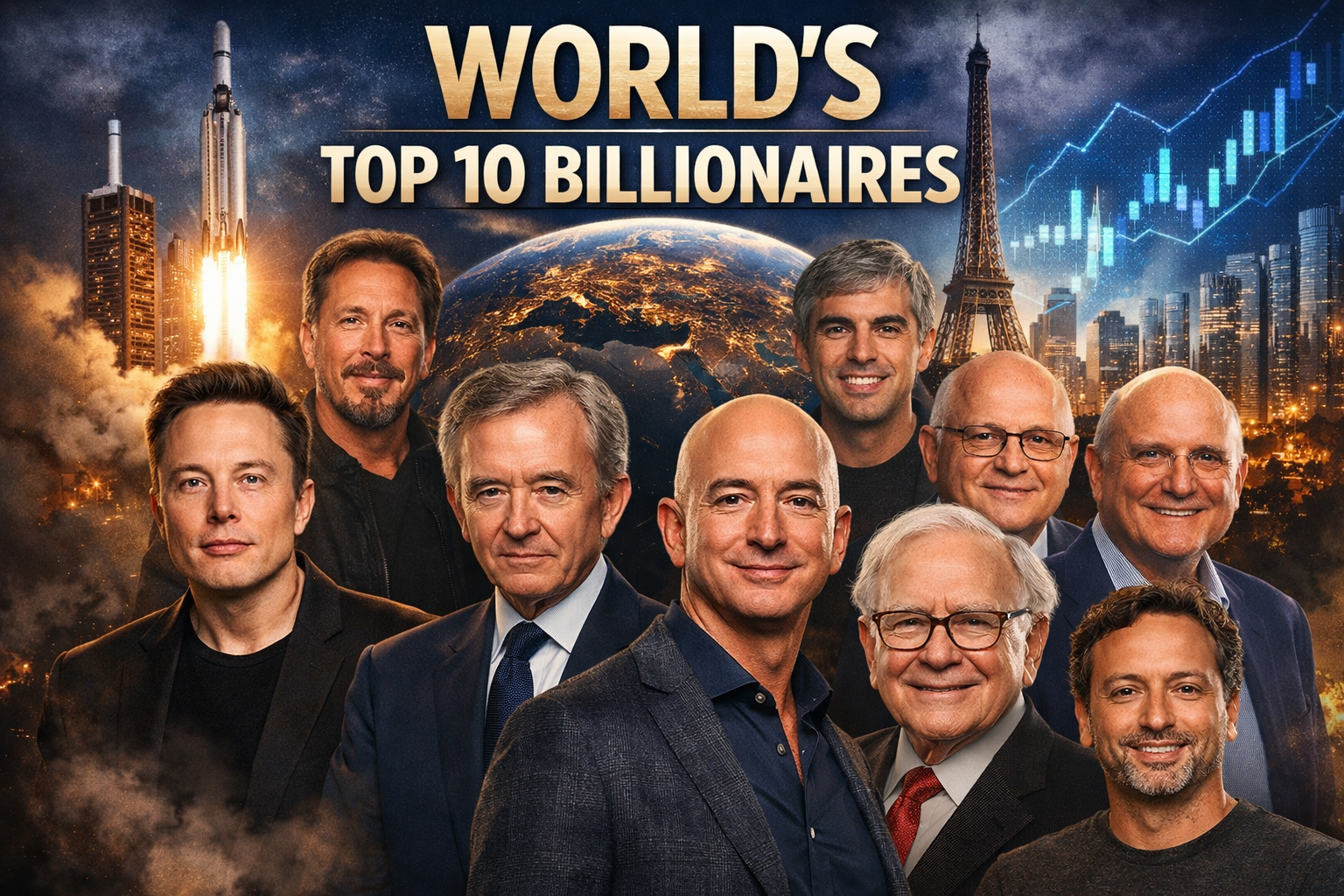
      World’s Top 10 Billionaires: The annual ranking of the World’s Top 10 Billionaires is more than a list of extreme wealth—it’s a snapshot of global economic power, innovation, and influence. These individuals sit at the intersection of technology, luxury, finance, and digital platforms, shaping how the world shops, communicates, invests, and even explores space.

      From Silicon Valley disruptors to European luxury titans, the billionaires on this list have built empires that transcend borders. Their fortunes rise and fall with markets, but their long-term impact on industries and society remains undeniable. Below is a Forbes-style, SEO-optimized overview of the Top 10 Billionaires of the Year, highlighting who they are, how they made their money, and why they matter.

      Top 10 Billionaires in the World

      1. Elon Musk

      Industry: Electric Vehicles, Space, Artificial Intelligence
      Why He Ranks at the Top:
      A symbol of bold innovation, Musk’s wealth is powered by electric mobility, private space exploration, and future-focused technologies that continue to disrupt traditional industries

      2. Bernard Arnault

      Industry: Luxury Goods & Fashion
      Key Strength:
      As the force behind the world’s largest luxury group, Arnault dominates global fashion, cosmetics, and lifestyle markets driven by premium brand demand.

      3. Jeff Bezos

      Industry: E-commerce, Cloud Computing
      Wealth Driver:
      Bezos revolutionised global retail and logistics while building one of the most profitable cloud computing ecosystems in the world.

      4. Larry Ellison

      Industry: Enterprise Software, Cloud Technology
      Business Edge:
      A pioneer in database software, Ellison’s company remains deeply embedded in global corporate and government IT systems.

      5. Mark Zuckerberg

      Industry: Social Media, Digital Advertising
      Growth Engine:
      Zuckerberg’s wealth reflects the massive scale of social networking platforms and long-term bets on immersive digital experiences.

      6. Warren Buffett

      Industry: Investments, Insurance
      Why He Endures:
      Renowned for value investing and patience, Buffett’s diversified holdings make him a constant presence among the world’s richest.

      7. Bill Gates

      Industry: Software, Philanthropy
      Beyond Business:
      While his fortune stems from software dominance, Gates is equally influential through global initiatives in health, education, and climate action.

      8. Larry Page

      Industry: Internet, Search Technology
      Revenue Base:
      Search, digital advertising, and AI-led innovation continue to fuel Page’s position among the world’s elite billionaires.

      9. Sergey Brin

      Industry: Internet, Artificial Intelligence
      Innovation Focus:
      Brin’s fortune grows alongside advances in data, automation, and next-generation computing.

      10. Steve Ballmer

      Industry: Technology, Sports Ownership
      Diversification Strategy:
      Ballmer blends legacy software wealth with high-profile investments beyond tech, showcasing strategic diversification.

      The World’s Top 10 Billionaires of the Year reflect how vision, scale, and timing can transform ideas into global empires. As markets evolve, these individuals will continue to influence not just wealth rankings but the direction of the global economy itself.

    4. The Forbes Billionaires List: The Top 10 Richest People in the World and What Their Wealth Reveals About the Global Economy

      The Forbes Billionaires List: The Top 10 Richest People in the World and What Their Wealth Reveals About the Global Economy

      Wealth at the very top of the global economy is no longer static. In an era defined by real-time markets, instant information, and interconnected capital flows, billionaire fortunes can rise or fall by billions of dollars in a single trading session. This is precisely why the Forbes Real-Time Billionaires list has become one of the most closely watched financial rankings in the world.

      Unlike the annual Forbes World’s Billionaires list, which captures net worth at a fixed moment in time, the real-time list updates continuously during market hours. It reflects stock price movements, currency fluctuations, and shifts in public company valuations, offering a living snapshot of who holds the greatest concentration of wealth on the planet at any given moment.

      But the list is more than a scoreboard. It is a window into the industries, technologies, and economic forces shaping the modern world. The individuals at the top are not simply wealthy; they are deeply influential, controlling companies that affect how people communicate, shop, travel, invest, and consume information.

      Below is a detailed, Forbes-style examination of the current top 10 richest individuals frequently appearing at the top of the Forbes Real-Time Billionaires ranking, followed by an analysis of what their dominance says about global wealth today.


      Understanding the Forbes Real-Time Billionaires Methodology

      Before examining the top 10, it is important to understand how Forbes calculates real-time wealth.

      For publicly traded companies, Forbes updates billionaire net worths using real-time stock prices multiplied by known shareholdings. For private companies, valuations are adjusted daily using market indexes, comparable public firms, and industry performance. Assets such as real estate, cash, yachts, art, and private investments are also factored in, though they are updated less frequently.

      The result is not a perfect measure of liquid wealth, but rather the most accurate publicly available estimate of a billionaire’s economic power at a given moment.


      1. Elon Musk

      Primary industries: Electric vehicles, space, artificial intelligence, advanced manufacturing
      Country: United States

      Elon Musk has spent much of the past decade oscillating between first and second place on the global wealth rankings, but he remains the most closely watched billionaire in the world. His fortune is anchored primarily in his ownership stakes in Tesla and SpaceX, with additional exposure to artificial intelligence, robotics, and other frontier technologies.

      Musk’s wealth is highly volatile because it is closely tied to equity valuations rather than dividends or cash flow. When Tesla shares surge or SpaceX’s valuation increases, his net worth can climb dramatically. When markets turn risk-averse, it can fall just as quickly.

      What distinguishes Musk from many of his peers is the breadth of his ambitions. His companies operate at the intersection of transportation, energy, aerospace, and AI, sectors that governments and investors alike see as strategically critical. As a result, his wealth is not only immense but deeply intertwined with the future direction of industrial and technological development.


      2. Jeff Bezos

      Primary industries: E-commerce, cloud computing, logistics
      Country: United States

      Jeff Bezos transformed retail by building Amazon into the dominant global e-commerce and cloud computing platform. Although he stepped down as CEO, Bezos remains one of Amazon’s largest shareholders, and the company continues to be the foundation of his fortune.

      Amazon Web Services, in particular, has become one of the most profitable segments in the entire technology sector, supplying cloud infrastructure to governments, corporations, and startups around the world. This steady stream of high-margin revenue helps stabilize Bezos’s position among the top tier of global wealth holders.

      Beyond Amazon, Bezos has invested heavily in aerospace through Blue Origin, media through ownership of The Washington Post, and a wide range of venture capital initiatives. His wealth reflects not just retail dominance, but control over critical digital infrastructure.


      3. Bernard Arnault and Family

      Primary industries: Luxury goods, fashion, consumer brands
      Country: France

      Bernard Arnault is the most prominent non-American billionaire at the very top of the Forbes rankings. As chairman and CEO of LVMH, the world’s largest luxury conglomerate, Arnault oversees a portfolio of more than 70 globally recognized brands, including Louis Vuitton, Dior, Fendi, Moët & Chandon, and Hennessy.

      Unlike many tech billionaires, Arnault’s wealth is rooted in brand power, craftsmanship, and consumer aspiration. Luxury goods have proven remarkably resilient, even during periods of economic uncertainty, as high-net-worth consumers continue to spend on prestige products.

      Arnault’s position highlights the enduring value of strong brands and global distribution networks. While technology dominates the upper reaches of the billionaire rankings, luxury remains one of the few non-tech sectors capable of producing generational wealth on this scale.


      4. Larry Ellison

      Primary industries: Enterprise software, cloud computing
      Country: United States

      Larry Ellison, the co-founder of Oracle, represents an earlier generation of technology wealth, but his relevance has not faded. Oracle remains a major force in enterprise software and cloud infrastructure, serving governments and corporations worldwide.

      Ellison’s wealth is built on long-term ownership rather than constant innovation headlines. Oracle’s steady revenues, combined with Ellison’s disciplined approach to retaining equity, have kept him near the top of the rankings for decades.

      In addition to technology, Ellison has invested heavily in real estate, including significant holdings in Hawaii, further diversifying his wealth beyond the tech sector.


      5. Mark Zuckerberg

      Primary industries: Social media, digital advertising, artificial intelligence
      Country: United States

      Mark Zuckerberg built one of the most influential companies in modern history by founding Facebook, now Meta Platforms. With billions of users across Facebook, Instagram, WhatsApp, and Messenger, Meta remains a cornerstone of the global digital advertising ecosystem.

      Zuckerberg’s wealth has experienced sharp swings in recent years as Meta invested heavily in virtual reality and long-term AI initiatives. While these bets initially unsettled investors, renewed focus on efficiency and artificial intelligence has helped restore market confidence.

      His position among the world’s richest underscores the continued economic power of attention, data, and global communication networks.


      6. Larry Page

      Primary industries: Internet services, artificial intelligence
      Country: United States

      Larry Page, co-founder of Google, helped create the foundation of the modern internet economy. Alphabet, Google’s parent company, continues to dominate online search and digital advertising while expanding into cloud computing, AI, and advanced research.

      Page’s wealth is largely passive today, reflecting the enduring value of Google’s core businesses rather than day-to-day management. Alphabet’s investments in artificial intelligence, including large-scale language models and automation, ensure that Page’s fortune remains closely linked to the future of computing.


      7. Sergey Brin

      Primary industries: Internet services, artificial intelligence
      Country: United States

      Sergey Brin, Google’s other co-founder, shares much of his economic story with Larry Page. Together, they created one of the most profitable business models ever devised, turning search data into a global advertising engine.

      Brin has become more involved in AI-related initiatives in recent years, reflecting the central role artificial intelligence now plays in Alphabet’s long-term strategy. His wealth highlights how early technological breakthroughs can compound over decades when paired with strong network effects.


      8. Steve Ballmer

      Primary industries: Software, sports ownership
      Country: United States

      Steve Ballmer amassed his fortune primarily through Microsoft, where he served as CEO during a period of enormous growth. Although he left the company years ago, Ballmer remains one of Microsoft’s largest individual shareholders.

      His wealth has benefited from Microsoft’s resurgence as a cloud and AI powerhouse, demonstrating how legacy technology companies can reinvent themselves. Ballmer’s ownership of the Los Angeles Clippers also reflects the growing role of sports franchises as high-value investment assets.


      9. Jensen Huang

      Primary industries: Semiconductors, artificial intelligence hardware
      Country: United States

      Jensen Huang, co-founder and CEO of Nvidia, is one of the most significant beneficiaries of the global artificial intelligence boom. Nvidia’s graphics processing units have become essential infrastructure for AI training, data centers, and advanced computing.

      Huang’s rise into the top tier of global wealth is a reminder that hardware remains just as critical as software in shaping technological revolutions. His fortune is closely tied to the continued expansion of AI across industries.


      10. Michael Dell

      Primary industries: Computer hardware, enterprise technology
      Country: United States

      Michael Dell built his fortune by revolutionizing the personal computer business and later transforming Dell Technologies into a major enterprise IT provider. His long-term ownership and strategic acquisitions have allowed him to retain control while navigating shifts in the technology landscape.

      Dell’s presence in the top 10 reflects the enduring value of infrastructure and enterprise solutions in a world increasingly dependent on digital systems.


      What the Top 10 Reveal About Global Wealth

      The Forbes Real-Time Billionaires top 10 is overwhelmingly dominated by technology and technology-adjacent industries. Software, cloud computing, artificial intelligence, semiconductors, and digital platforms account for the majority of extreme wealth creation today.

      At the same time, Bernard Arnault’s position demonstrates that consumer brands, when scaled globally and managed effectively, can rival even the largest tech fortunes.

      Another striking feature is geographic concentration. Most of the world’s richest individuals are based in the United States, reflecting the depth of U.S. capital markets, innovation ecosystems, and investor appetite for growth.


      Final Thoughts

      The Forbes Real-Time Billionaires list is more than a ranking of individuals. It is a constantly updating map of where economic power resides and where it is heading. Each name in the top 10 represents not just personal success, but entire industries and technological shifts that shape everyday life for billions of people.

      As markets evolve and new technologies emerge, the rankings will continue to change. But the underlying lesson remains the same: in the modern global economy, ownership of scalable platforms, intellectual property, and networks is the most powerful driver of extraordinary wealth.